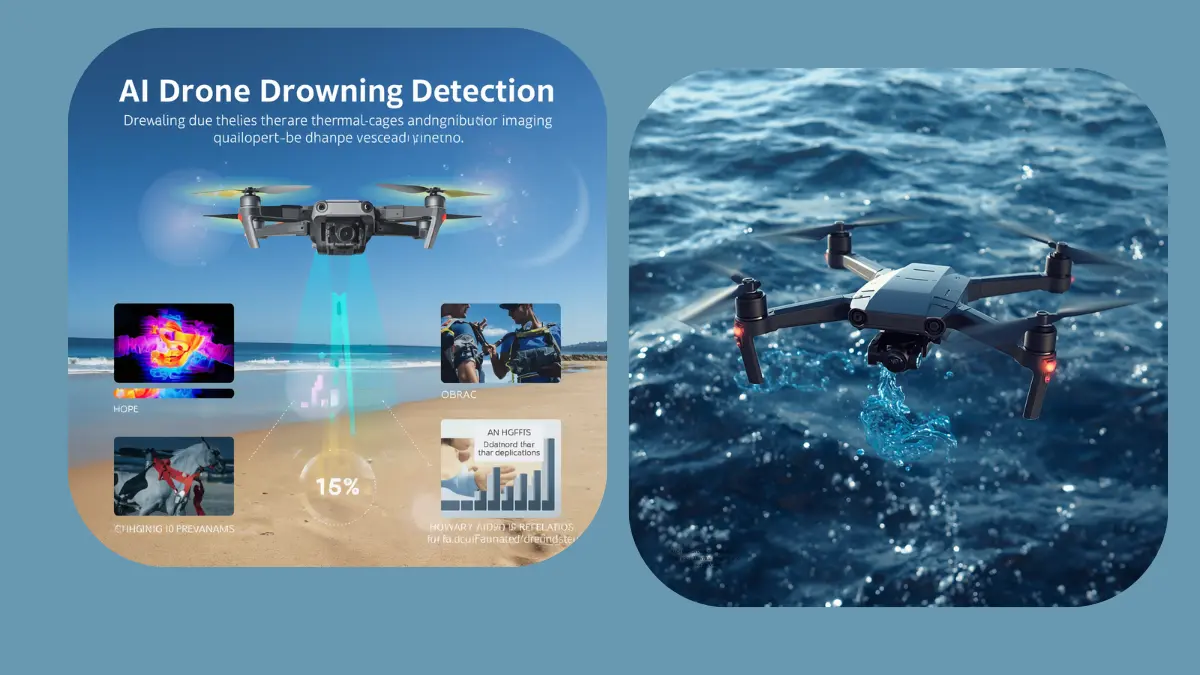
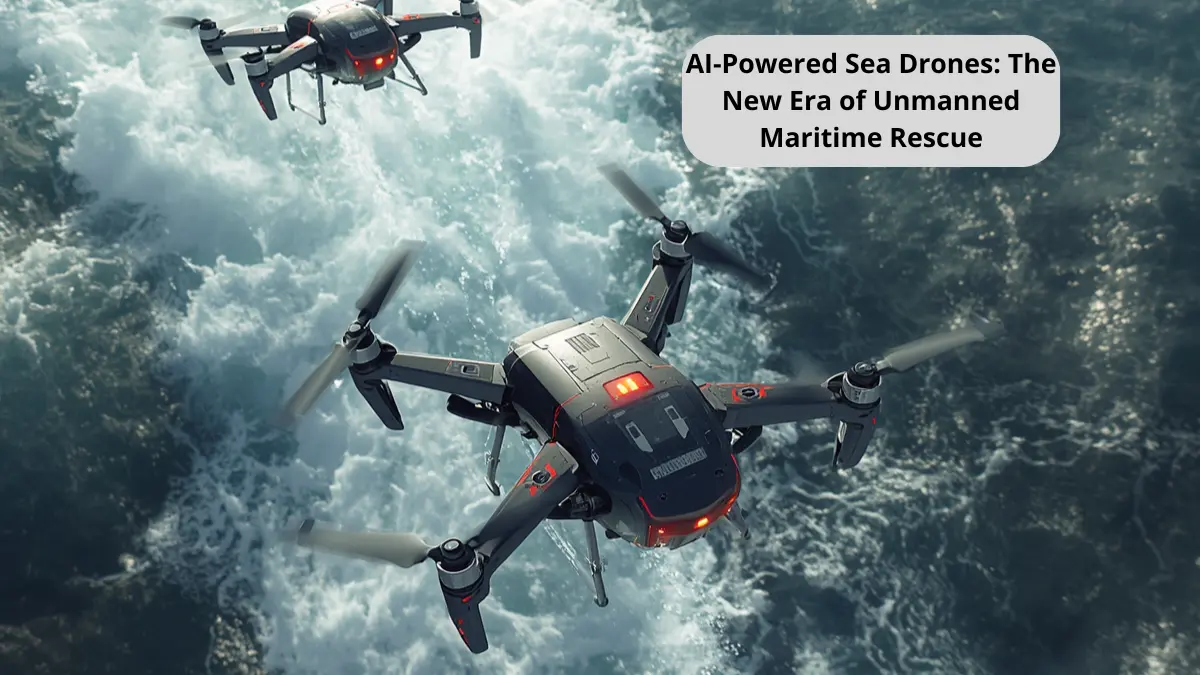
Locating a struggling swimmer in the open ocean is an extreme visual challenge. Traditional search and rescue methods rely heavily on human eyesight, which is easily compromised by solar glare, breaking waves, and sea foam. To bypass human limitations, modern maritime rescue gadgets combine autonomous flight with advanced AI drone drowning detection software, driven by thermal infrared (IR) sensors and deep learning algorithms.
By processing multi-spectral video feeds directly at the tactical edge, these AI-powered drones can detect a human head bobbing among violent waves within milliseconds, vastly increasing survival rates in critical situations.
1. The Core Architecture of AI Drone Drowning Detection
Autonomous maritime search operations do not just record video; they analyze every single pixel in real-time. A professional AI drone drowning detection system relies on an embedded computing pipeline consisting of specialized hardware and trained neural networks:
[Thermal Sensor (FLIR)] ──> Radiant Heat Data ──> Edge Computer (Jetson Orin) ──> YOLOv8/v10 Inference ──> Guard Alert
Edge AI Hardware
Due to the latency constraints of sending raw video to the shore, drones utilize onboard edge computing modules like the NVIDIA Jetson Orin Nano or Xavier NX. These low-power modules run deep learning models directly on the aircraft.
Convolutional Neural Networks (CNNs)
Systems are built using custom-trained object detection architectures like YOLOv8 (You Only Look Once) or SSD (Single Shot MultiBox Detector). These models are fed thousands of training images of human heads, floating limbs, and life jackets in various water states to minimize false negatives.
Read Also:
Optimizing Water Rescue Drone Motors: Low-KV vs. High-KV Configurations
Google and XREAL Unveil Project Aura: The First True Android XR Spatial Glasses
Temporal Tracking Algorithms
To differentiate between a piece of floating debris and a human, the software tracks objects over time using algorithms like ByteTrack. If an object appears, disappears beneath a wave, and reappears with a consistent heat signature, the AI flags it as a human target.
2. Thermal Infrared (IR) Physics in Maritime Environments
Optical cameras are useless at night and struggle during high-glare sunny days. Thermal imaging sensors (such as FLIR Boson cores) solve this by measuring long-wave infrared (LWIR) radiation (8–14 μm).
The Temperature Differential (ΔT)
Human core body temperature (~37°C) creates a stark thermal contrast against cold ocean water (typically 10°C–20°C). The thermal camera registers this as a high-intensity cluster of pixels.
The “Thermal Masking” Challenge
Water has a very high thermal emissivity, meaning it reflects thermal radiation from the sun and sky. Breaking waves create “thermal noise” that can mimic human heat signatures.
The AI Solution
To combat thermal noise, the AI software implements Dynamic Range AGC (Automatic Gain Control) and spatial filtering. The algorithm constantly subtracts the moving background average of the ocean temperature, isolating only the sudden, concentrated heat spikes of a human face or body.
3. Multispectral Sensor Fusion: Optical + Thermal
The gold standard for drone rescue gadgets is Sensor Fusion. Instead of relying on one camera, the drone carries a dual-sensor gimbal payload that combines an optical RGB camera with a thermal sensor:
| Sensor Type | Strengths | Weaknesses | AI Role |
|---|---|---|---|
| Optical RGB (4K) | High spatial resolution; captures colors and life jacket text. | Blinded by darkness, heavy fog, and solar glare. | Identifies visual distress markers (waving arms, bright colors). |
| Thermal IR (LWIR) | Works in absolute darkness; pierces through light fog and glare. | Lower resolution; cannot see through deep water. | Detects the metabolic heat signature of the victim’s head. |
The AI software overlays these two video streams using a process called Pixel-Level Registration. If the thermal channel detects a heat signature and the optical channel confirms human movement patterns at the exact same GPS coordinates, the system triggers an emergency alert to the lifeguard station with 99% confidence.
4. Real-World Case Study: Regulus and DJI Zenith AI Systems
In practical beach safety, technologies like the Regulus SAR Software paired with enterprise drones showcase the maturity of this tech. When deployed over public shorelines, the software automatically scans the water using a grid-search pattern.
If a swimmer stays submerged past a threshold or exhibits panicked thrashing patterns, the computer vision algorithm calculates the exact latitude and longitude coordinates. It instantly forwards this data to local coast guards while autonomously instructing the drone to hover directly above the victim, dropping a self-inflating buoy.
Conclusion: The Ultimate Autonomous Lifesaver
For a drone gadget to truly revolutionize maritime search and rescue, it must move beyond manual piloting. Implementing a ruggedized AI drone drowning detection payload transforms a simple flying camera into an automated, proactive lifesaver capable of conquering the optical and thermal complexities of the open sea.
Discover more from Tech News Radar
Subscribe to get the latest posts sent to your email.